Showing posts with label Singapore. Show all posts

Wednesday, March 5, 2014

Singapore Is The World's Most Expensive City


PETALING JAYA: If you think living in Paris, London, Tokyo or New York is expensive, wait until you cross the causeway down south!

Malaysians will most likely think twice now before holidaying in Singapore after The Economist Intelligence Unit (EIU) listed the island republic as the world’s most expensive city to live in.

In the Worldwide Cost of Living 2014 report, a bi-annual survey, the city-state steadily increased its cost of living from 10 years ago when it was listed as 18th most expensive.

“Over the last decade, a 40% currency appreciation, coupled with solid price inflation, has consistently pushed Singapore up the ranking,” said the report.
To put the price of things into perspective, transport costs in Singapore are nearly three times that of New York, the most expensive city in North America.

The report also explained that the island’s reliance on other countries for basic necessities such as energy and water has inflated utility costs.

The other nine cites which topped the list for most expensive in the world were Paris, France (second); Oslo, Norway (third); Zurich, Switzerland (fourth); Sydney, Australia (fifth); Caracas, Venezuela (sixth); Geneva, Switzerland (seventh); Melbourne, Australia (eighth); Tokyo, Japan (ninth) and Copenhagen, Denmark (10th).

For those on a budget, now is the time to visit Mumbai, which has claimed the spot as least expensive city.

Other cities listed as 10 most affordable are Karachi, Pakistan (second least expensive); New Delhi, India (third); Damascus, Syria (fourth); Kathmandu, Nepal (fifth); Algiers, Algeria (sixth); Bucharest, Romania (seventh); Panama City, Panama (eighth) and Saudi cities of Jeddah and Riyadh.

Source: The Star

Wednesday, December 11, 2013

Singapore riot: Timeline of events

SINGAPORE: The police in a press conference on Tuesday evening gave a chronological breakdown of what happened on Sunday night in Little India.

Here is a look at the timeline as told by the police:

9:23pm: Police are informed of a serious road traffic accident.

9.25pm: Singapore Civil Defence Force are alerted to the incident.

9.31pm: First ambulance arrives at the scene.

9.37pm: The first police fast response car arrives at the scene.

9.38pm: First fire engine arrives. A crowd of about 100 have congregated.

9.41pm: Police reinforcements start arriving.

9.45pm: The crowd has swelled to about 400 by this time.

9.54pm: The body of worker is extricated from under the bus. Mob starts pelting emergency officers and are holding dangerous weapons like drain covers.

10.11pm: Police shield bus driver and time keeper to ambulance. Mob behaves aggressively and hinders police efforts.

10.30pm: First group of Special Operations Command (SOC) officers arrive.

10.37pm: Police activate a major recall of patrol cars islandwide. A total of 53 police cars activated.

10.44pm: SOC officers get into formation and began to disperse mob. Police arrest suspects.

11:45pm: Mob is dispersed.

12.01am: Investigations at the scene commence.

12.39pm: Deputy Prime Minister Teo Chee Hean arrives with Deputy Commissioner of Police T. Raja Kumar.

5.03am: National Environment Agency begins clean up of site.

6.30am: Roads are passable to traffic.


- The Star

Singapore Riot: Disturbing Questions


SINGAPORE: Singaporeans who witnessed or watched videos of the wanton lawlessness in Little India on Sunday would have been deeply shaken by the spiralling contagion, intensity and seeming mindlessness of the mob.

How could the single death of an Indian national due to a tragic accident spark such a rampage when the victim could hardly have been known to many of the South Asian workers who had randomly gathered at the scene?

Barbaric rage was directed at police officers and civil defence personnel who were there to render assistance.

Yet, they were pelted with harmful objects even as they attempted to extricate the accident victim's body.

Whatever the feelings and underlying grievances of the mob, there was no call to harm others striving to do their duty, or to burn vehicles.

Whatever the street culture and attitudes towards authority in their country of origin, such madness has no place whatsoever in Singapore.

In curbing mobs, police face a dilemma in applying the classic theory of the crowd that attributes the influence of agitators and the grip of mutual excitation to why ordinary individuals lose control of their behaviour.

But an iron-fisted approach can worsen an emerging situation, as held by the contemporary theory of how the social identity of people can change (for example when indiscriminate force is used against them) and unite them in further violence.

As the anatomy of the riot is dissected by the Committee of Inquiry that is to be set up to probe its causes, a range of public views will likely form about the incident and its handling. 

Whatever one's leaning, it would be prudent for judgments to reflect a sense of proportion. First, such incidents are rare and public order is well maintained. It has been decades since the Hock Lee bus riots of 1955, remembered for the chaos caused by striking bus workers and Chinese middle-school students. 

Second, millions of migrant workers have contributed to the economy since the 1980s and the 400 who rioted in Little India represent only a fraction of the largely law-abiding transient workforce here - work permit holders in construction alone now number over 300,000. 

Though hopelessly outnumbered, there were also peacemakers in the unruly crowd, as shown by at least one video of a brave individual restraining others from violence.

Hence, it would be wrong to adversely typecast all foreign workers as the result of this incident, despite its undoubted gravity. Also important is the need to keep a finger on the pulse of migrant worker communities to better understand the issues they face. 

One way is to harness informal community leaders and mediators to educate and engage the constantly shifting pool of workers who throng not just Little India but also other spots on weekends. - The Straits Times/ANN

Tuesday, December 10, 2013

Singapore riot: Complete alcohol ban in Little India this weekend

SINGAPORE: There will be a complete ban on the sale and consumption of alcohol this weekend in the Race Course Road area where a riot broke out in Little India on Sunday night.

Second Minister for Home Affairs S Iswaran told reporters on Monday evening that details of the ban, such as exactly what time it will apply and what geographical area it will cover, will be worked out by the police.

Though it is too early to say definitively what caused the riot - which was triggered after a fatal traffic accident - it is "plausible that alcohol consumption was a contributory factor", he added.

"And that is why we have taken this step in the first instance in order to stabilise the situation."

Transport Minister Lui Tuck Yew, who is the MP for the ward in Moulmein-Kallang GRC, said that he has wanted curbs on the sale of alcohol in the area for some time, after seeing the proliferation of liquor licences there.

"I know my residents will fully support this immediate measure," he said. He and Mr Iswaran were speaking to the media after a visit to the area, during which they spoke to shopkeepers. - The Straits Times/ANN

Singapore's First Undersea Road


Not long now: A sneak peek at Singapore’s first undersea road tunnel at the Marina Coastal Expressway. — The Straits Times / Asia News Network
THE Marina Coastal Expressway (MCE) – Singapore’s first undersea road, costliest expressway and one with the widest tunnels – will open on Dec 29, four years after the S$4.3bil (RM11bil) project started.
The 5km expressway, at S$860mil (RM2.2bil) per kilometre, has a 420m section that goes under the sea-bed just south of the Marina Barrage.
Linking the Kallang-Paya Lebar Expressway to the Ayer Rajah Expressway (AYE), it will allow swift east-west travel. Drivers currently using the East Coast Parkway (ECP) to join up with the AYE can switch to the MCE from Dec 29.
The ECP will be downgraded to an arterial road that serves the Marina downtown. — The Straits Times / Asia News Network

Singaporeans Stunned By Riot

SINGAPORE: Singaporeans are still in a state of disbelief that a riot by a group of foreigners at Little India actually happened in this relatively trouble-free island late Sunday night.

Bank employee Eugene Leong, 28, said that it was difficult to digest the images of about 200 foreigners attacking several police patrol cars, ambulance, a bus and setting them on fire.
"Its not something that you would think would ever happen, especially in Singapore, as we are famed for our stringent regulations.
"Watching the incident on the news was shocking and scary and now many of us want to know what action will be taken to make sure it doesn’t happen again," he said when interviewed along Race Course Road where the rioters ran rampant.
Leong said that while action should be taken against those involved, the government should immediately beef up police presence, especially in areas where there were high number of foreigners.
"Another option that could be looked into is to limit the timings for selling alcohol so that drunkards do not loiter around the shops and later cause trouble," said the 28-year-old.
Investment consultant Davian Sim,30, also said that he was shocked when news broke out about the riot.
"We have never heard of such thing happening here and the last major riot were the racial-based ones that occurred in 1969," he said.
He added that the incident was a frightening one that could repeat itself if action was not taken.
"The government should study the matter and come up with ways to deal with this.
"One way could be to adopt a policy from Australia where open drinking in public places is prohibited," he said.
Meanwhile, resident S. Ram Prakash, 14, who witnessed the whole incident from his home on the 17th floor of a nearby flat said that it was beyond frightening.
"Seeing the angry mob attack the bus with sticks and rubbish cans was something that I will not forget.
"The group could not be controlled and continued to cause havoc even after a group of about 10 policemen were deployed to the area," he said.
He added that the most frightening was when rioters set fire to several police petrol cars and overturned the vehicles.
"I believe that they were all drunk because they were dancing and shouting as the fires blazed," he said, adding that the crowd dispersed only when riot police were deployed.
Ram said that the whole fiasco ended at around 12pm and the remains of the burnt petrol cars were cleared up at around 4am on Monday morning.

- The Star

Monday, December 9, 2013

Singapore Got Riot?


Singapore's Deputy Prime Minister Teo Chee Hean (front R) and Minister in Prime Minister's Office S Iswaran (front 2nd R) look at the site of two burnt vehicles following a riot in Singapore's Little India district, December 9, 2013. REUTERS/Rob Dawson

SINGAPORE (Reuters) - A crowd set fire to vehicles and clashed with police in the Indian district of Singapore late on Sunday, in a rare outbreak of rioting in the city state.

The incident reportedly started after a private bus hit and killed a foreign worker in the Little India area. Television footage showed a crowd of people smashing the windscreen of a bus, and at least three police cars being flipped over.

Singapore Police Force said the riot started after a fatal traffic accident. "Shortly after, a riot broke out involving a crowd of about 400 subjects where the subjects damaged five police vehicles and one ambulance," it said in a statement, adding that around 10 police officers were injured.

Little India is usually packed with people on Sundays, with many construction workers from Bangladesh and India gathering there to spend their day off.

Incidents like this are rare in Singapore, which has tough laws on rioting that carry a sentence of up to seven years in prison and possible caning.

"This is a serious incident which has resulted in injuries and damage to public property," said Teo Chee Hean, Deputy Prime Minister and Minister of Home Affairs. "Police will spare no efforts to apprehend the subjects involved in the riot."

The breakout is likely to fuel concerns about discontent among low-paid foreign workers. Last year Singapore saw its biggest outbreak of labour unrest in years when around 170 bus drivers from mainland China went on strike illegally.

Footage on Channel NewsAsia showed at least two vehicles on fire and debris strewn across Racecourse Road, one of the main thoroughfares in Little India. Many other private cars were reported to have been damaged as well.

Police reported at 1 a.m. on Monday morning (1700 GMT on Sunday) that the incident was under control.

(This story has been refiled to change 'showing' to 'showed' in second paragraph)
(Reporting by Rachel Armstrong; Editing by Mark Trevelyan)

Tuesday, September 29, 2009

Henderson Wave

Open spaces are scarce in a compact city of 4.99 million people. Shopping malls are still the prefered public spaces for people to hangout after work or during weekend. But the trend is definitely changing. In line with global warming threat as well as green movement all across the globe, people are more conscious about healthy lifestyle. And the healthier way of living is not working out 2 hours a day in an air-conditioned gym; but to go back to basic and being 'embraced' by nature.

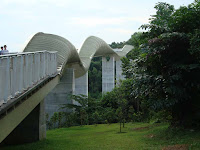
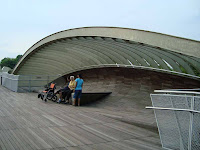
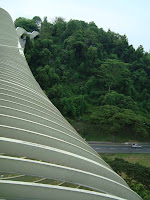
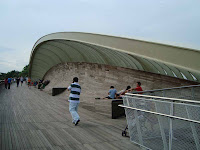
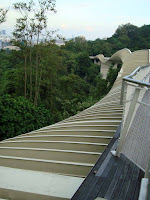
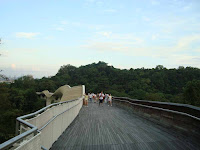
In a city where land is as precious as gold, creative thinking is put to good use in coming up with ideas to provide better living environment. Henderson Wave was the result of such creative approach. Perched at 36 metres above Henderson Road, the 274 metres long and 8 metres wide 'sculpture' is the highest pedestrian bridge in Singapore. It was built to link Mount Faber to Telok Blangah Hill. By bridging the 2 hills, it provide an unprecedented opportunity for the residents of Singapore to have a much bigger green lung within their city. Its function however is not merely establishing linkages; but creating a new public domain at the same time. The bridge itself is a popular weekend hangout area for many.

To call it a pedestrian bridge is an understatement. Henderson Wave is a perfect example of the integration of ART, SCIENCE and NATURE to serve a noble social agenda!

Saturday, September 19, 2009

Modernism

At the beginning of the 20th century, inspired by the aspiration of Industrial Revolution and agitated by the destruction of World War I to create a better future, a group of architects initiated the Modern Movement. With the arrival of the Machine Age then, standardization was made possible. This mass production approach not only benefitted the auto industry but architecture as well. Architects realized that they could rebuilt their medieval cities into a thriving modern metropolis with the help of the technology of the day in an unprecendented speed. Le Corbusier envisaged the modern city as consists of high-rises organized in an orderly fashion. Thoroughfares would be straight and well connected. Residential floor plates would be stacked one on top of another. The buildings would be standardized as to achieve a consistant order in the scheme.


This idea of urban design has indeed survived today and most notably in Singapore. With about 80% of its population living in government initiated public housing, it makes sense to utilize the modernists' approach in making the dream of house ownership a reality. Hence the creation of the more commonly know HDB (Housing Development Board) Flats all over the island. Mass production and standardizatoin serve this objectives well which is to provide affordable housing to its people at an efficient pace. Most parts of a single unit are precast off-site in order to reduce wastage as well as speed up construction.


In implementing this approach, building design has to comply strictly with HDB's guidelines. Drastic modification from the prescribed floor plans are not encouraged. As a result, the buildings ended up very similar to each other and not much individual characteristics in them. The only ways to identify the block you are staying are through Block Number and sometime the color scheme on the wall. There are some variations on the facade but mostly not substantial. This certainly gives rise to problems pertaining to identity of place. With no significant natural features such as hills and water to define a place, these mass-produced buildings lack unique identity to create a recognizable 'place'.

Howeve, HDB housing is a success story in that it makes house ownership easier to be achieved. Consequently, there is no slum in Singapore. Many countries have tried to emulate its success to achieve their own social agenda. In terms of practicality, it has achieved its objectives. Its downside lies in its failure in 'place making' which will give the city a unique identity to its inhabitants as well as an admiration to visitors.

Saturday, September 12, 2009

358 Days in Singapore

The original objective of coming to Singapore for 9 months has been met, in fact has been exceeded by 3 months! It was indeed a valuable lesson to experience first hand the difference between Singapore and Malaysia. Singapore has shown that how good management can propel us to greater heights against all odds. It is a slight culture shock to see different races mingle together in a truly harmonious way in Singapore; something which the Malaysian politicians have been preaching all along but no action whatsoever. All the answers to Malaysia's problem could be found in Singapore if the government is humble enough as to recognize it. I have long try to refrain myself from talking politics in my blog but I just can't help to notice how far behind Malaysia is in terms of nation building. It is no point having the highest twin towers in the world when the fundamental social structure is still in the same condition before independence; or even has deteriorated.

Some might ask, can we change it? Malaysia celebrated its 52nd National Day recently, we are 52 years old already! Middle age crisis has sink in and yet it is still in a mess. My personal opinion is change will happen, but unfortunately will not be in my lifetime...............

Migration is the logical answer for now.

Friday, September 4, 2009

350 Days in Singapore

Time flies, today is my 350th day working in Singapore. The time now is 6:05am.
Singapore is a vibrant city with a sustainable economy. Comparing it to Penang, it is easier to do business here. Everywhere you go, there are people. Together with an efficient public transport system, people can be moved from place to place in a breeze. This fast flowing pattern of people is the ingredient for a fast progressing economy. And the government never feel contented at what their country has achieved so far, they continuously coming out with ideas on how to further raise the living standard of its citizen. This is indeed the most obvious contrast I found when compare to my country Malaysia where politicians are more concern with securing their ruling power.
For career development, Singapore is a much better place to consider due to its more systematic and advance way of doing things. But for living I still consider Malaysia home because of its flexibility and less intense way of life. Well, it is never easy to get the best of both worlds.
Sacrifices have to be made somehow.

Sunday, July 12, 2009

2nd Anniversary @ Minori Restaurant, Singapore


We celebrated our 2nd Anniversary in a simple manner at this Japanese restaurant at UE Square, Dhoby Ghaut. Atmosphere was good, not that crowded (which is a rare scene in Singapore) and the food was good. The only downside was that the salmon wasn't that fresh. Other than that, everything else was perfect!

Monday, May 25, 2009

Kiasu-ism

It is a well known fact that Singaporean are very ‘kiasu’ people. ‘Kiasu’ literally means afraid to lose in Hokkien. This type of behavior can be easily witnessed especially in crowded areas. Once I was on board of the MRT train, it then stopped at an interchange where all the passengers were required to alight the train, walked across the platform and board another train to continue their journey. There was a family standing beside me, father, mother and a son. As soon as the train stopped, the father commanded his son to quickly ran towards the other train and ‘grab’ the seats. He himself also rushed across the platform. I could easily see from where I stood that there were still lots of empty seats available, there was no need to rush at all. That day, the ‘kiasu’ legacy has been successfully passed on from father to son, generation to generation. I’m sure this young kid will behave exactly like his father when he has his own family in the future.

The Root of the ProblemHowever, the MRT is not the reason why Singaporean become a ‘kiasu’ species. The cause of this behavior can be traced back to 1965 when Singapore was asked to leave the Federation of Malaysia. A small island without any resources, its leaders were very concerned about Singapore future. Without Malaysia as its hinterland, how could it possibly survive and prosper. The feeling of insecurity was definitely there. Forced in such a desperate situation, Singapore struggled to be first to grab foreign investment to develop its economy. This was the mood then and one might asks why does Singaporeans still feel insecure when their country has become so prosperous today. Surprisingly, the sense of insecurity is still there. From time to time, their leaders have reminded their citizen that if Singapore fails, no one in the region would ever lend a helping hand to support it. They are reminded that Singapore is a First World Oasis surrounded by Third World Countries (that include Malaysia as well).

The RelevanceAlthough Malaysian are not famous for kiasu-ism, I can see similarities in our education industry. Private colleges and universities are fighting each other for a very small pool of resources (i.e. students). Every institution wants to be the first to launch a new program, give attractive scholarship and other promises. Everyone seems to be doing the same thing at the same time. These marketing activities have taken up a lot of the academics’ time and effort at the expense of quality in education.

In terms of priority, there are three ways in my view which must be done in order to attract students:
· Retain passionate lecturers
· Set strict marking scheme
· Motivate students by means of awards (without any imposed conditions)

These approach may not yield result in the short term, but will definitely raise the standard of the programs. In the long run, it will attract not only students but committed lecturers as well.

Tuesday, April 28, 2009

Creating Identity


MASTER PLAN / URBAN DESIGN CONCEPTS
The Housing District West at Punggol has been envisaged to be a new benchmark for housing development in Singapore. The uniqueness of the site is the creation of the Punggol Waterway and hence the emphasis of the relationship between development and water. The mapping and reading of the master plan is multivalent rather than hierarchical. The architecture, public spaces, connective tissues and movement systems are dispersed across a series of interpenetrating green connectors that weaves across the site to facilitate bridging to the waterway. There are two major elements in our design: visual connections and eco linkages. These elements are superimposed on a pre-determined general layout of major road networks and water infrastructure. The superimposition generates a sequence of interstitial spaces suggesting fluid movements and connections to various parts of the development.

Visual ConnectionThe entire Housing District West is designed and developed as a whole based on generating vistas open towards MRT/LRT stations, water and communal nodes. By emphasizing direct visual connections, the entire site establishes strong relationship with its surrounding context. Distinct places are created which could be easily identified and differentiated from one another. Each communal node is different in terms of its form and levels. Visual axis are created to enable way finding from wherever location throughout the site. Key visual connections are from communal nodes to LRT/MRT stations, community node to communal node and communal nodes to the waterway. These connections enable one to position him/herself within the site in relation to its surroundings. The visual connection between one communal node to another also enlarges the perceptible dimension of each park within its own precinct and thus add to the qualitative experience of the public domain.

Eco LinkagesThe entire Housing District West was looked at as a potential large green lung in line with HDB’s idea of ‘Green Living by the Waters’. The housing quarters are composed of series of linear buildings twisted to form clusters that enclose major public spaces within the site. The clustering of the residential blocks enhances sense of community as well as privacy at the same time. These individual precinct parks will then be connected to each other by means of eco pathways. These landscaped pathways meandering through the entire site to form a continuous ecological structure. Within each precinct, the landscaped platforms are flexible, reacting to site conditions. These platforms vary in width to accommodate different public activities. They are programmed with sports, leisure playing fields and playgrounds. Everywhere one goes, the qualities of a green housing district can be felt due to the dynamic arrangement of building blocks that resulted in a very porous environment within each plot. The criss-crossing of broad paths and trails takes one past a series of courts, lawns and a range of recreational activities. The creation of the E Deck within each precinct also means that car parking is kept below the platforms to make way for an uninterrupted and safe pedestrian network above.

With the merging of green, water and residential, Housing District West will be an area that has strong unique identity and conducive for living. It is a synthesis of approach focusing on the ideas of connection and bridging; interaction and interrelation of ordering systems; and integration of natural systems of green and water with the built environment.


HOUSING DESIGN SCHEMES

The buildings are designed with sustainability and flexibility in mind. With the ever increasing demand of the end users, a lot of consideration is taken into account in order to produce a good design that is both aesthetically pleasing and functionally practical at the same time.

Building Orientation
Most of the building blocks are oriented along the East-West axis wherever possible in order to exploit the full potential of the waterfront site. This orientation also helps in solar shading of the building blocks and thus reducing the need for artificial cooling.

Building Massing
The buildings were deliberately designed to have different heights in order to avoid the whole scheme being read as series of monotonous concrete walls throughout the entire site. Those blocks that are closer or fronting the waterway are intentionally designed as low rise buildings which will then create a more human scale streetscape along the promenade. To make up for the required density, maximum number of units are stacked up at those blocks located at the deepest end of the site furthest away from the waterway. This configuration allows for views towards the waterway for most of the blocks including those at the back.

Views and Identity
The linear blocks are meticulously shifted and twisted in order to allow maximum number of dwelling units having views towards the waterway as well as Sungai Punggol. The twisting form of the buildings give the much needed identity to each block so as to avoid rigid and ‘faceless’ architecture. Residents will be able to identify their home by the form of the buildings instead of merely rely on block number signage on the walls.

Green Roof
Planting on roof surfaces acts as thermal barrier for the top floor units creating a cooler environment.

Thermal BarrierInsulated west facing gable end walls increase U-Value thus keeping homes cool, reducing the need and energy load for air-conditioning.

Natural Ventilation
Units are pulled apart allowing prevailing North-South winds to keep the corridors cool and naturally lighted.

Modular SizingDimensions of structural elements are standardized together with use of precast elements for efficiency.

Reconfiguration PossibilitiesThe unit floor plans are designed to suit various residents’ needs. Structural clarity and standardization are emphasized to enable flexibility in rearrangement. Columns and shear walls are kept at the periphery with all the intermediate walls being partition. This allows for the intermediate walls to be omitted or added at ease.

Thursday, February 26, 2009

Lesson from Singapore - Lighting


Robert Venturi once wrote a book entitled “Learning from Las Vegas” where he elaborate on the importance of public’s participation in architecture by means of consumerism. Ad hoc signage along the streets of Las Vegas has significantly gave the town its identity. It is a fact that architects learn from their environment, however there are also a handful of egoistic individuals who think that they are above the natural system by proclaiming the originality of their creation. They proclaim that their ideas purely came from their mind, not inspired or making reference to anything and they claim absolute ownership of the design. This is the greatest lie of all time and they are merely deluding themselves.

As such, it is important that we always keep our eyes open and absorb the myriad things around us. There is nothing to be ashamed of in learning from someone who is far superior than us. The worst thing that can happen is when we think that we are the best and stop progressing. It is an undisputed fact that Penang is way backward than Singapore in many ways. But we should not be in a denial stage forever. Why not learning from people who have been through the same experience and have made progress along the way.

‘LEARNING’ is too casual a word. I feel that urgent action has to be taken to bring back the shine to Penang. That is the reason I choose the word ‘LESSON’ due to its stronger implication. The first lesson that I’m going to highlight here is about lighting. Thanks to the advance in technology, we can now have very attractive lighting at a very low cost. LED (light emitting diodes) is the latest features that can be found in most landmarks due to its attractive colors as well as cost effective reasons. It is cheaper than the conventional up lights that shine on the façade of major buildings. In Singapore, the government has guidelines on which type of light to be used in certain areas. Up lights are still being used for big public buildings like museum due to the grandness effect that it produce. In a more trendy and up-market shopping district like Orchard Road, LED lighting can be spotted in most of the shopping malls. It also helps in attracting customers to its door.

Penang actually has a few good examples such as the e-Gate and Suntec building. However, most public buildings such as the City Hall are not lit at night except for the eve of public holiday. If cost is the main concern, the authority should consider using LED to highlight certain architectural elements of major landmarks and it could be turned on every night!

Saturday, February 21, 2009

Monday, February 9, 2009

Sakura

Finding a good place to dine is indeed a challenge in Singapore, not that there is no place at all. On the contrary, there are plenty of choices wherever you go around the island. The only problem is finding a less crowded place with good food.

It is not surprising that with a population of 4.84 million, people have to 'reserve' their seating place in foodcourt by placing TISSUE on the seats! It is pathetic! Sometimes I was quite frustrated looking for a place to have my lunch.

Until one day Joelyn and I found this little place at the middle of nowhere: Sakura International Buffet Restaurant @ Admiralty Park. To get there, you have to take the MRT to Woodlands Station, then take bus 903 from berth no. 4. When you see a huge campus with lots of green on your right, press the bell and alight at the second bus stop. Then walk across the road and you will see the Sakura signboard at the open carpark.

The restaurant is located at the bottom of the car park. It is indeed a very clever way of playing with the terrain of the site to tuck it below street level. And yet when you take the stair down and finally arrive at the restaurant's entrance, you don't feel that you are at underground. By having skylights with trees growing all the way up to the car park above and opening up the whole frontage to a lotus pond in front, the interior is very bright and refreshing.

And of course the food..........they have Sashimi, my favourite! Not to mention that the price is very affordable - SGD48.00 for 2 pax.

Wednesday, January 14, 2009

Duality


Reconciliating duality has been my approach in design for a while. I guess I was very much influenced by the writings of the late Japanese architect Kisho Kurokawa. Personally I feel that Kurokawa's writings were better conceived than his architecture. I was interested in the way he tried to identify the differences between Western and Japanese architecture because I think his theory is also applicable to Asian sensibilities in general.

In this design for a proposed 'Future School', the idea is to stay away from the conventional classroom layout by introducing nature into the interior of the learning areas. The classrooms are physically enclosed but 'consciously' open to the outside. 2 classrooms sandwiched a garden in between which also serves as outdoor learning area. The wall adjacent to the corridor stops short of the ceiling and floor to allow lighting penetrate into the interior. Colored boxes of inspiration are inserted on this wall which appear to be sliding against each other. Translucent color coated glass will be used to allow natural light illuminates the classroom.

A few display areas will be located along the corridor as a transcient exhibition space for students' works. The design is to create a 'performing stage' for students' presentation. As they are located along the public circulation area, more exposure and interaction among students is expected.

Monday, January 5, 2009

Hitting the Right Note


There are times when we scribble sketches which could look like drawings so bad that even a three year old could do better. We would continue to explore our ideas through these sketches until our dustbin is full of crumbled butter paper that spilled onto the floor. And at the end of the day we still haven’t got the slightest clue of what the buildings is going to look like. We then take a break, go for a walk or even play some games sort of to relax our mind and hopefully we would be struck by an inspiration. Sometimes these repetitive exercises could continue for days without any apparent materialization.

However, there are also times when we just know it! When every lines we draw fall onto their correct positions effortlessly. When there is no other option except the one we drew in front of us. The experience is like when a painting reflects exactly the aspiration of the artist. We have hit the right note within us. Such is the moment when we whisper to ourselves that: “Yes, there is truth in architecture after all!”

AGA Christmas Party 2008


We celebrated Christmas by having party at the office on 23rd Dec 2008. One of my colleague brought his PS3 and some of us were addicted to the games. Another one brought along his guitar and started singing solo. This is the first time I experience such a relax atmosphere in an architecture firm and it was fantastic! One of the directors even bought wine and beer to share with everyone! I always like red wine and this is no exception this time that I think I drank more wine than everybody else that day. I didn't get drunk of course, I always know how to control my limit. I just want that floating feeling if you know what I mean.....
Anyway, 2008 has just passed and we are on a new year now. Geez......time flies, I'm getting old and yet still so many things I want to do!
Happy New Year to everyone!!!